

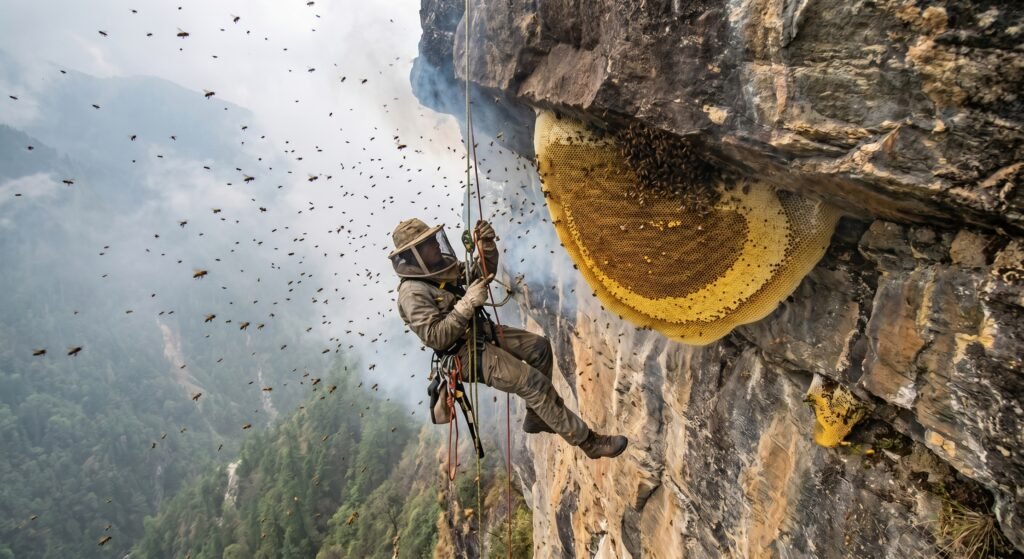
Imagine dangling dozens of feet in the air, suspended only by climbing ropes against a sheer rock face or towering canopy tree. Surrounded by a swirling cloud of thousands of defensive bees, a harvester carefully maneuvers a blade to slice away a massive, golden honeycomb.
This is the breathtaking reality of extreme wild honey harvesting—a rare glimpse into one of the most daring foraging practices in the world. But what exactly is happening in this high-altitude ecosystem? Let’s break down the science, the species, and the immense skill behind this incredible process.
The Architects: Giant Wild Bees
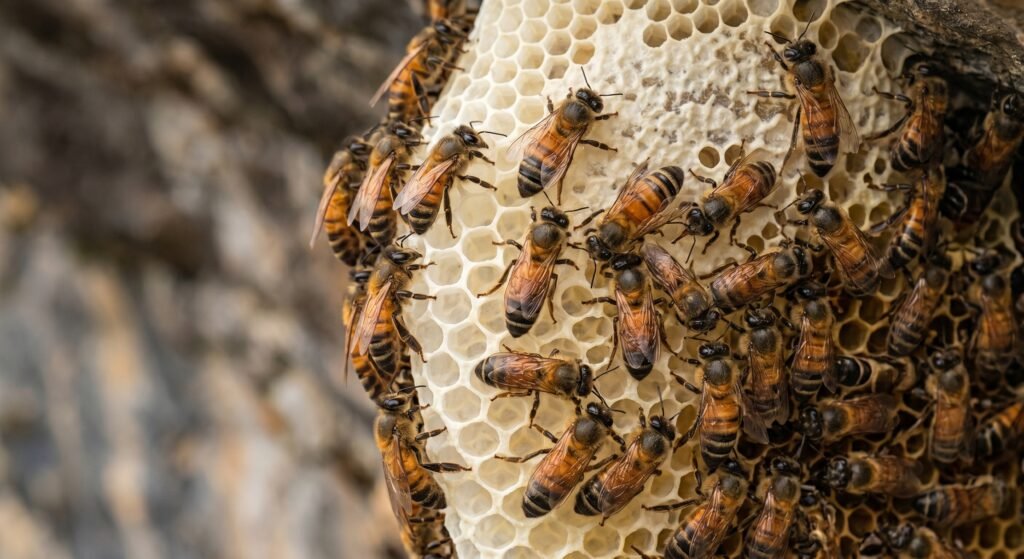
Unlike the common Western honey bees (Apis mellifera) that live comfortably in stacked wooden boxes managed by beekeepers, the bees responsible for these colossal structures are entirely wild. They belong to species like the Giant Honey Bee (Apis dorsata) or the Himalayan cliff bee (Apis laboriosa), native to parts of Asia.
These wild bees are significantly larger than standard honey bees, but their most defining characteristic is how they build their homes. They do not nest in enclosed, dark cavities or hollow tree trunks. Instead, they are open-air architects.
To protect their precious honey and larvae from ground-dwelling predators like bears and honey badgers, they construct massive, single combs high up on sheer cliff faces, under rock overhangs, or beneath the thick branches of towering jungle trees.
The Anatomy of a Megahive
The sheer scale of these wild combs is astonishing. A single comb can measure over a meter (3 to 5 feet) across, weigh up to 100 pounds, and hold tens of thousands of bees. Because the comb is completely exposed, the bees themselves act as the hive walls; they link their bodies together to form a living, shimmering blanket that regulates the temperature of the wax and defends against threats.
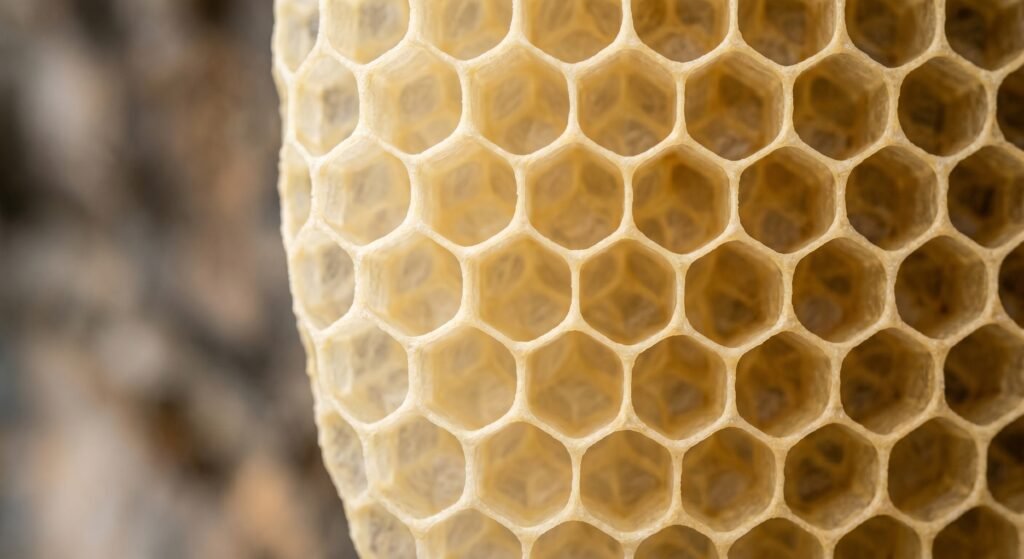
When you look closely at the freshly cut comb, you are witnessing a true marvel of natural engineering. The honeycomb is made of beeswax secreted from the bees’ abdomens, molded into perfect, interlocking hexagonal cells. Mathematically, the hexagon is the most geometrically efficient shape possible. It provides the maximum amount of storage space for heavy liquid using the absolute minimum amount of structural wax, preventing the massive comb from snapping under its own weight.
Mountaineering Meets Foraging
Because these bees build their nests at such dizzying heights, harvesting the honey requires a unique combination of advanced rope access and traditional foraging knowledge.
The beekeeper must be fully secured with climbing harnesses, carabiners, and heavy-duty ropes to maneuver while dangling in mid-air. Wearing a specialized protective suit is absolutely non-negotiable; giant honey bees are highly defensive and possess a potent sting. Often, a smoker is used to gently blow smoke over the hive. The smoke does not harm the bees; rather, it masks their alarm pheromones and keeps the colony calm during the process.
When it comes to extracting the honey, extreme precision is required. A sustainable harvester will carefully slice away only the heavy, honey-filled outer section of the comb without dropping it into the abyss below. Crucially, they leave the “brood” (the upper section attached to the rock where the bee larvae live) completely intact so the colony can survive, rebuild, and continue to pollinate the surrounding forest.
Nature’s Purest Nectar
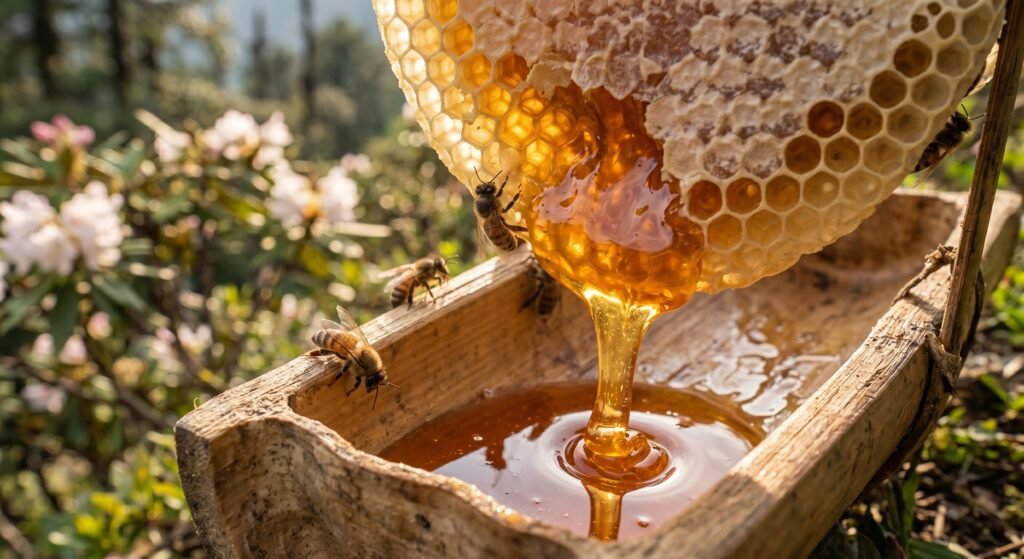
The thick, vibrant amber nectar dripping from the freshly cut cells is honey in its absolute purest, most primal form.
Because wild giant bees forage across vast areas of untouched forests and high-altitude flora, the nectar they collect comes from a massive variety of wild plants. This gives the honey a highly complex, robust flavor and a rich color that directly reflects the local ecosystem. Furthermore, because it is harvested straight from the comb, it is completely raw and unprocessed—retaining all of its natural pollens, active enzymes, and antioxidants.
Extreme honey harvesting is a profound display of human courage intersecting with natural wonder. It serves as a powerful reminder of the intricate brilliance of wild pollinators and the fascinating ecosystems they support.
Keep Exploring the Natural World
Nature is full of incredible, hidden processes that showcase the brilliance of the animal kingdom and the fascinating ways humans interact with the earth.
If this deep dive into wild honey harvesting sparked your curiosity, there is so much more to discover!
[👉 Click here to explore our library of articles and dive deeper into the wonders of biology, wildlife, and our incredible planet.]