

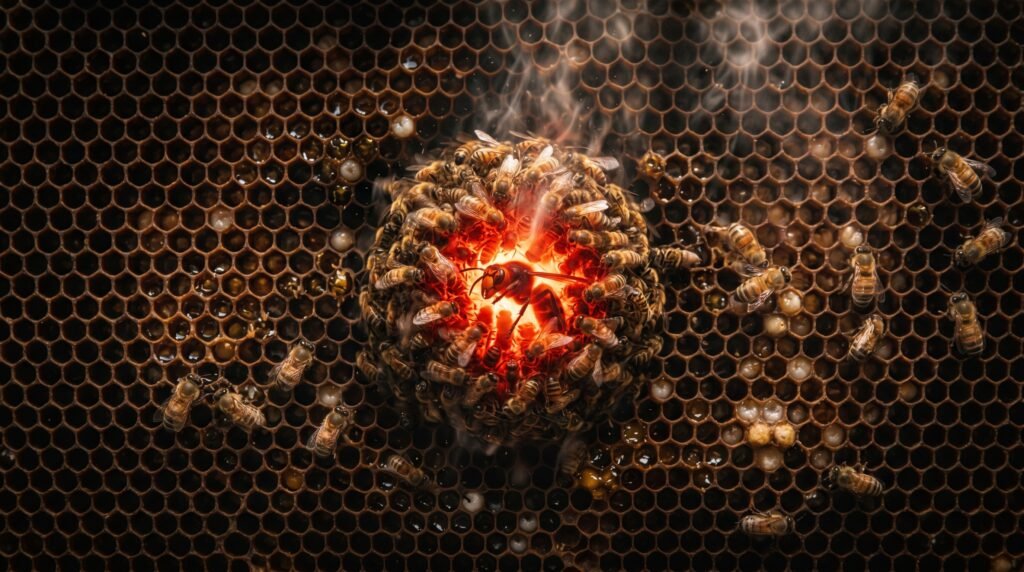
If you are coming from our viral video, you just witnessed one of the most brutal, brilliant, and terrifying survival tactics in the entire animal kingdom. You saw the bees turn themselves into a living oven to cook an invading hornet.
But it leaves one massive, burning question: If it gets hot enough to roast a giant hornet alive… why don’t the bees cook themselves?
The answer lies in a terrifyingly precise, microscopic margin of error. But first, you have to understand the threat.
🛑 The Ticking Time Bomb
In the insect kingdom, the Asian Giant Hornet (often called the “Murder Hornet”) is the ultimate apex predator. It is massive, heavily armored, and equipped with jaws that can decapitate a honeybee in a fraction of a second.
To a peaceful beehive, a single hornet is an existential threat. If a “scout” hornet finds a hive, it will fly back to its nest, bring an army of 30 hornets, and slaughter a colony of 30,000 bees in a matter of hours.
When the scout enters the hive, the bees know it cannot be allowed to leave. But there’s a massive problem: the hornet’s armor is too thick for bee stingers to pierce. They can’t fight it. They can’t sting it. So instead… they cook it.
🐝 The Swarm: Springing the Trap
When the scout hornet enters the hive, the Japanese honeybees don’t immediately attack. They wait. They let the heavily armored hornet get deep inside the honeycomb.
Suddenly, a chemical signal is released. In a split second, a wave of over 500 honeybees launches onto the hornet. They don’t try to bite; they simply pile on top of it, locking their bodies together to form a dense, inescapable sphere known as a “Heat-Ball.”
🌡️ The Oven: Vibrate to Kill
Once the hornet is completely buried in the center of the ball, the bees execute one of the most brilliant biological tactics on Earth. They uncouple their wings from their flight muscles and begin to violently vibrate their chests.
When 500 bees shiver their muscles simultaneously, they generate massive amounts of kinetic energy and body heat. Inside the center of the ball, the temperature skyrockets. Furthermore, the heavy breathing of hundreds of vibrating bees raises the carbon dioxide levels inside the ball, suffocating the hornet and lowering its ability to withstand extreme heat.
⚖️ The “One-Degree” Margin of Life and Death
This is where nature’s math gets incredibly precise. Here is exactly how the bees survive their own trap:
- The Giant Hornet can only survive temperatures up to 115°F (46°C).
- The Japanese Honeybee, however, has evolved to survive temperatures up to 122°F (50°C).
The bees aggressively vibrate their muscles until the inside of the ball reaches exactly 117°F (47°C). They hold this exact temperature for nearly an hour. They push the heat past the hornet’s breaking point, literally roasting it alive from the inside out, while staying comfortably below their own lethal limit.
Once the hornet stops moving, the ball breaks apart. The scout is dead, the signal is never sent, and the colony survives to see another day.
📺 Watch The Epic Battle Again!
Did you miss the video that everyone is talking about? Watch our incredible visual simulation of the Heat-Ball Assassination right here:
👇 https://web.facebook.com/share/r/18Y8Ac6GYD/ 👇
🌍 The Harsh Reality
This incredible defense mechanism is exclusive to the Japanese Honeybee. Unfortunately, European Honeybees (the ones we usually use for agriculture in the West) never evolved alongside these giant hornets, meaning they don’t know how to form a Heat-Ball. If a giant hornet enters a European hive, the colony is completely defenseless.
Nature is a constant, brutal arms race. Sometimes, survival isn’t about having the sharpest weapon—it’s about knowing how to turn up the heat.